Showing posts with label Museums. Show all posts

Saturday, October 17, 2015

Miccosukee Indians


Never heard of the Miccosukee Indians?  Neither had we until we came across this tourist attraction on the Tamiami Trail in the Florida Everglades.  Originally part of the Seminole tribe, these people were those than remained in the area after the forcible relocation of Indians after the Seminole Wars.  They banded together and were officially recognized by the Federal government in the 1960s.  They are fiercely independent and still practice many of the ways of their ancestors.


This "art" piece greeted us in the parking lot.  A little tacky looking, we weren't sure the entrance fee would be worth it.


Entrance to the village

This attraction is well worth the price of admission, if only for the opportunity to tour the museum on the grounds.  The village itself is a bit Disney-esque, but does educate the visitor about traditional practices, with tribe members cooking, carving and sewing. The Miccosukee are a very closed tribe, preferring to keep their traditions such as song and dance, to themselves.  Rich in history, they do run a casino, but many of the tribe still hunt and fish in the old way, the women do patchwork and make baskets and all pass along these traditions to the youth.


Sample basketry

This structure is called a chickee and is the preferred home for some to this day.  Several of these structures are built within close proximity with each having a separate function such as sleeping, cooking or gathering.  The chickee can withstand hurricane force winds and provides all the protection needed in south Florida.


Traditional patchwork
Each of these samples represent patterns that have meaning to the Miccosuckee.  For example, the orange one is fire; others are crab or turtle or other things that the women use to tell a story.

Totem

Unfinished carving

Sample carved goods

A little hokey, we watched the alligator "wrestler."   He made it a point to tell us the alligator wasn't "trained"; rather that it took skill and care to handle the gator.

Alligator "wrestler"

The star of the show

Getting up close and personal

The gator pond contained alligators of all sizes; babies, teenagers, adults and old guys.  Apparently, they live peacefully with turtles because the pond contained several of them as well.

Best friends?

Alligator skull

Sid riding a Florida panther

Me and my live alligator buddy
Not!

Like a lot of things we've done on this trip, this unplanned activity was well worth the time spent.  We learned about a proud people who, despite the government's desire to banish them, banded together and are thriving on their own terms.  If you ever find yourself in the Everglades and think there's not much to see, think again and visit this attraction.

Since we had opted for a quiet boat ride, we still had a ride in an airboat on our bucket list.  With a newly found respect for the Miccosuckee people, we decided to give them our business and take a second ride through the Everglades.

View from the airboat

Another view
At first glance, it kind of all looks the same, but there is quite a variety of grasses and flowers.

A Miccosuckee home
A cluster of chickees built on a platform in the middle of the wetlands, this home is still used for gatherings today.  These homesteads are dotted throughout the Everglades.

Can you see the alligator?

The ride in the airboat was fun.  The young man driving did some trick steering on the way back, to give us a little thrill, I guess, and it was interesting to drive straight at a huge clump of grass and clear it without feeling a bump or anything.  So, another bucket list item checked off!

I knew I couldn't leave Florida without trying alligator.  It was okay, but I don't think I'd put it on the menu on a regular basis.  

Gator bites
Tastes like chicken!

We ended up spending 5 days and 4 nights in the Everglades.  We spent time watching the resident alligator and Sid did some fishing in the lake in the campground until the gator would put a stop to it.  He would allow the fishing for a little bit, then would come, Jaws-like, across the lake to wherever Sid was standing.  Funny! I'm still not sure why anyone would choose to live in an area with a climate like the Everglades but I guess it takes all kinds.  Our visit was enjoyable and yours will be, too, if you get a chance to go.

Until next time...


Tuesday, October 13, 2015

Today's The Day!


Mel Fisher was the "World's Greatest Treasure Hunter."    For 16 years, he and his family searched the waters around Key West to locate the sunken treasures of the Atocha and the Santa Margarita, Spanish galleons that sank during a hurricane in 1622.  He suffered many personal losses, including a son and daughter-in-law, while pursuing his dream. but each day he would get up and declare "Today's the day!"   Once he discovered the ships, he endured many court battles to keep the estimated $450 million treasure that included gold, silver and emeralds.  While visiting Key West, we took the time to tour his museum, learn about his quest and see a portion of the haul.

Before we entered the museum, however, there was a very interesting display in the courtyard.  On August 4, 2015, there was a breaking story about some Cuban immigrants who landed in Key West, causing a firestorm of controversy in the news about the "wet foot, dry foot" policy in our country.  In front of Mel Fisher's museum was the homemade vessel in which they traveled.   Made of 55 gallon drums and what looked like wooden pallets, 24 people braved the dangerous 90 mile sea journey in this vessel.


Boat to freedom
I can't imagine even going for a ride near the shore in a boat like this, let alone out into the open sea!


Anyway, back to the museum.  There was a short documentary about Mel Fisher's dream and the costs, both personal and financial.  But he worked and lived for his dream and, happily, it became a reality.  Some of the artifacts he found are displayed throughout the building.

Dishware
These pieces are in amazing shape for being buried under the sea for over 350 years.

Gold bullion
Some legal, some contraband, each legal piece is marked with a tax stamp.

Gold chains
Since bullion was taxed at a higher rate than jewelry, much of the gold transported from the New World to the Old World was made into chains.  Links of the chains could be used as money, as well.

Jewelry
The tiny, intricate details survived the years and these pieces look like they were made yesterday.

Silver ingots
What excitement the divers must have experienced when they first discovered these!

"Pieces of Eight"
Spanish reales, heavily documented in fact and fiction, were the most reliable currency of the time period.


This display shows the transition of a crossbow from discovery on the floor of the ocean to restored condition.  Some of the other items displayed were so heavily encrusted that I can't imagine how the divers knew to retrieve them.

The second floor of the museum was dedicated to the lives of pirates and the role they played in the establishment of Key West.  Often used interchangeably, the terms pirate, privateer and buccaneer have very different meanings.  A pirate plundered for cargo and his acts were punishable by death.  A privateer attacked ships while under contract to a government.  The goods taken were then split with that government and the privateer never plundered their own country's ships.  Buccaneers were the pirates of the Caribbean and formed a loose network dedicated to causing as much havoc to the Spanish fleets as possible.  

Key West was established by Navy Lt. Commander Matthew Perry to be a naval depot whose sole mission was to end piracy.  In a politically controversial move, he sailed into Key West and claimed the territory previously seen as "North Havana" as part of the US.  At the time, the keys and Cuba were well known as havens for pirates and illegal slavers.

Buccaneers were primarily of French and English descent.

Entering the museum display

I think this guy was there to make sure we didn't steal anything!

While I was not expecting to get much out of this museum, it ended up being completely fascinating!  If you have a chance, read up on Mel Fisher and, too, the history of piracy.  And definitely visit the museum when in Key West.

Until next time...

Wednesday, August 26, 2015

Who Came First?


The National Park Service established the Timucuan Ecological & Historical Preserve, in part, to memorialize the human histories of the area. We visited on  a whim, following a sign on the road, not knowing a thing about it.  I'm glad we did.  The visitor center holds artifacts unearthed and a display that details the activities that took place here.

Fort Caroline, on the banks of the St. Johns River near Jacksonville, Florida was established by the French in June 1564, predating St. Augustine's September 1565 by a few months. That same year, the Spanish traveled up the river, sacked the French and built their own fort on the same site.  They held the fort until 1568 when the French returned in revenge for the 1565 massacre, slaughtering all the Spaniards.  The Spanish rebuilt the fort, but permanently abandoned the site the following year.  So, while St. Augustine is, in fact, the oldest surviving city, I was surprised to discover that it was not settled first.

Fort Caroline
The fort has been recreated by the Park Service

Entrance to the fort

St. Johns river
This is the view from the fort.

The Timucua were American Indians that were instrumental in the survival of both the French and the Spanish who occupied Fort Caroline and its surrounding village.  Not generally unified, the tribes were varied and connected only through their use of a common language.

Owl totem
This extremely rare and unusual totem was enormous and its discovery, intact, seems amazing to me.
 
Typical Timucuan structure

 A little off the beaten path, this is the kind of treasure I love to find when traveling.  I'm once again reminded how lucky I am to live in a country that honors its past and preserves it for generations to come.

Until next time...


Tuesday, August 18, 2015

Museum at the Washington Navy Yard

Our neighbor in the campground was retired Navy and he recommended that we visit the Navy Museum at the Washington Navy Yard, the oldest shore establishment of the U.S. Navy.  We could drive into the yard and park nearby, so we took an afternoon to check it out.

I didn't what to expect - I know very little about the Navy - but it turned out to be pretty interesting.  Of course, Sid had to read every narrative displayed, so I after I looked at the things that interested me, I found a very comfortable bench and, prepared with my Kindle in my purse, read for the next hour and half while he finished up!

Some of the things I found interesting follow.

British blanket seized from a ship in the War of 1812
This was in pristine shape so it must have been taken before it was used much.

Diving suit
This suit was developed in Germany before WWII, but it's bulkiness prevented practical use.

Ship figurehead from the early 1900s.
I've never seen a male figurehead, so this was interesting.  It appears to be Prince Regent, who later became King George IV of England.  Interesting to me because my ancestors have been traced back to King George's court.

Kamikaze bomb plane
Designed to explode on impact, these were essentially bombs with wings.  I can't imagine the pilot flying this plane, knowing he was going to die.

Wing from Kamikaze plane recovered from the carrier Enterprise
Fourteen men died and another 68 were injured in this attack.

Watch bell from the USS Merrimack
Retreating Union forces burned and sank the ship to prevent her capture by the Confederates.

 
Pay receipt for POW work during WWII
Not an interesting picture, but I found it fascinating that the Japanese paid the POWs for their work.  The prisoners could then use the money to purchase needed medical supplies and extra food.

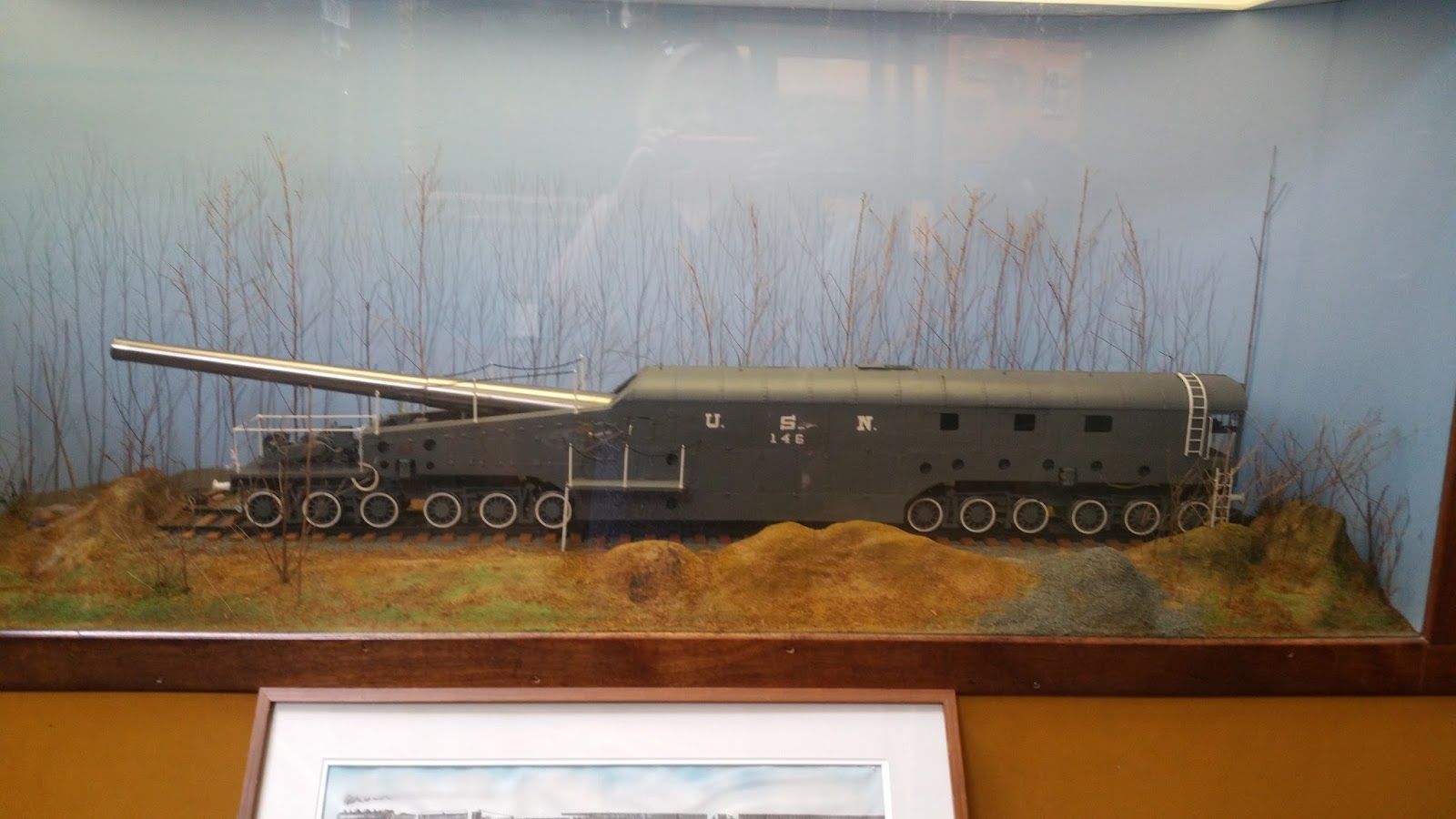
Railway gun

Model of railway gun
These railway guns were designed and built during WWI and used against the Imperial German forces.

That's just a fraction of the things on display at the museum.  Sid, knowing more about history than I do, found the narratives throughout very informative and educational.

And that, finally, wraps up our time in Washington, D.C., our nation's capitol.  The weather was beautifully sunny, but awfully hot and humid while we were there and, as always, there are many more things to see and do in and around the city.  But at least we got to cross a few things off the old bucket list!

Until next time...


Thursday, August 13, 2015

Honoring the Dead and the Living at Arlington


Did you know that the land occupied by Arlington National Cemetery was once owned by the grandson of Martha Washington?  And further, it was passed on to his daughter who married Robert E. Lee?  Thus, the Arlington House, Robert E. Lee's home, is located on the grounds today.  The complete history of how the cemetery is fascinating, but I'll leave you to read that by clicking on the link if you're interested.

The cemetery is so large, we took a tour bus to the different areas to see the most famous graves.  JFK, of course, and Robert Kennedy, the Tomb of the Unknown Soldier, the changing of the Guard and Arlington House.  It was miserably hot and humid the day we went, so we didn't spend much time wandering the graves as we would normally have done.

Eternal flame at John F. Kennedy's gravesite


The flowers were just gorgeous all over the cemetery grounds.

Amphitheater

Robert Kennedy's grave
You are supposed to have served in the military to be buried here, but I guess they made an exception for a Kennedy.

Watching the changing of the Guard

 
Changing of the Guard
We were lucky and honored to be able to see not only the changing of the Guard, but two wreath laying ceremonies while we were there.  Some official from Korea and his delegation, followed by the American Korean Veterans group.

First established during the civil war, the cemetery conducts between 27 and 30 funeral services each week day and 6 to 8 on Saturdays.  The grounds are filling up and there is a columbarium being built.  It's so sad to think of so many military men and women sacrificing their lives so that we may live free, but I'm glad that Americans are now in "honoring" mode.  We veterans do appreciate it!

Arlington House, also called the Robert E. Lee Memorial,  sits overlooking the cemetery and is the home where Robert E. Lee wrote the letter resigning from the U.S. Army.  Seized by the government for nonpayment of taxes, the Lee family sued and it was returned to them.  Lee's eldest son then sold the property back to the government and in 1955 it was designated as the permanent memorial.

Back parlor

Front parlor

Quilts in one of the bedrooms

Interpretive guide
She was standing around a corner and, when I first saw her, I though it was a mannequin.  Then she spoke and scared the living daylights out of me!

Exterior
It seemed like there isn't much money to keep the house is good shape.  I wonder if it's because it's dedicated to a Confederate leader?

Arlington is also the site for the Women in Military Service for America Memorial.  Being a veteran myself, I was most interested in this museum.  It honors the contribution of women during all eras and in all services.  There were fascinating displays of military uniforms and accoutrements from the Civil War to the present day.  On one wall were displayed photos, with biographies, of women who are in or have been in the military, representing women of all races, nationalities and ranks.

Front of the memorial

Comfort Quilt
Created by an active duty physical therapist on board the USNS Comfort, the quilt tells the story of the deployment of the ship to the Persian Gulf during Operation Iraqi Freedom.

Fallen Military Women Quilt
This quilt honors all the women who have died in the global war on terror.  Each woman's name and date of death is embroidered on the quilt.

So I was surprised to learn, as the title of this post indicates, that Arlington honors both the living and the dead of the military.  I'm proud to have served my country and proud that my country honors that.

Until next time...