Showing posts with label Historic Site. Show all posts

Wednesday, September 23, 2015

Botanical Garden in the Tropics


Fort Zachary Taylor was originally built on Key West for the purpose of manning guns to control the harbor. During the Civil War, the fort was held by Federal troops even though most citizens were Confederate sympathizers.  The West Martello Tower is a portion of the fort that was never fully completed.  In 1949, with the structure in decline, the Key West Garden Club took responsibility and developed the site into a beautiful tropical garden and event center.  In 1975, the site was declared a National Historic Site and today, people are welcome to tour the gardens for free.

The garden club attempts to grow any tropical plant, so there are specimens from many countries.  The gardens have meandering pathways through the vegetation and many of the plants are labeled.

The tunnel you see behind me is made of brick and part of the original structure.

This is the rest of the tree I'm standing by above.  It's called a Strangling Fig.

You can still see the gun portals in the walls of the structure

Unfinished walls
The tower was never finished, as you can see here.  The garden club has used the parts of the structure that are finished and preserves the rest as is.

 
The arched walkway was beautiful.

Interesting to see the interior of the structure walls.

Orchids and various tropical blooms

One thing really surpirsed me and that was the inclusion of so many succulIents and cacti in the gardens.  I've always associated cactus with desert climates, not tropical.

Agave
How much tequila could be made from this plant?

Aloe
This giant could supply all the aloe you'd need in a lifetime, I think.

 
Brain Cactus
When you looked closely at this, it really does resemble brain matter.

Many of the trees, plants and bushes had edible parts.  

Baby Coconuts
They start out yellow, then turn green, then brown.

Bananas
Not sure what the hanging down part is, but it was interesting to see.

Many of the recognizable (to me) plants were giant sized.  It makes our house plants that we try to grow seem puny! 

Look at the size of that palm frond!
  
Pothos is one plant I can't kill, but they never get to be this size!

Limes, anyone?
Even the garden art was super-sized.

Apparently, some trees are not designed to be climbed.  I thought only cactus had this type of protective parts.

Ruffle palm
Those spines are sharp!

Silk Floss Tree
I wouldn't want to try to climb this one, either.

Rain barrel
Being Key West, all the rain barrels were decorated like this one.

We had a great time wandering around the garden, being amazed at the variety and learning the names of some of the trees and plants we had seen on the island.  And since it's free, it's a great way to spend some off-the-beaten-path time in Key West.

Until next time...


Wednesday, August 26, 2015

Who Came First?


The National Park Service established the Timucuan Ecological & Historical Preserve, in part, to memorialize the human histories of the area. We visited on  a whim, following a sign on the road, not knowing a thing about it.  I'm glad we did.  The visitor center holds artifacts unearthed and a display that details the activities that took place here.

Fort Caroline, on the banks of the St. Johns River near Jacksonville, Florida was established by the French in June 1564, predating St. Augustine's September 1565 by a few months. That same year, the Spanish traveled up the river, sacked the French and built their own fort on the same site.  They held the fort until 1568 when the French returned in revenge for the 1565 massacre, slaughtering all the Spaniards.  The Spanish rebuilt the fort, but permanently abandoned the site the following year.  So, while St. Augustine is, in fact, the oldest surviving city, I was surprised to discover that it was not settled first.

Fort Caroline
The fort has been recreated by the Park Service

Entrance to the fort

St. Johns river
This is the view from the fort.

The Timucua were American Indians that were instrumental in the survival of both the French and the Spanish who occupied Fort Caroline and its surrounding village.  Not generally unified, the tribes were varied and connected only through their use of a common language.

Owl totem
This extremely rare and unusual totem was enormous and its discovery, intact, seems amazing to me.
 
Typical Timucuan structure

 A little off the beaten path, this is the kind of treasure I love to find when traveling.  I'm once again reminded how lucky I am to live in a country that honors its past and preserves it for generations to come.

Until next time...


Tuesday, August 25, 2015

The Oldest City

Although Santa Fe begs to differ, St. Augustine claims to be the oldest continuously occupied city in North America.  Only 40 miles or so from Jacksonville, where were staying, it was, we thought, an easy day trip to go see the sights.  Well, the single day turned into two days and we still didn't get to see everything that St. Augustine has to offer!

With a population of only around 13,000, the city was easy to navigate.  However, since there is so much history in the area, we opted to take another Hop On, Hop Off trolley.  This let us get an early overview of things to see, then decide where we wanted to spend time.

The architecture in the city is beautiful.  The brick and stone work is amazing - they sure don't build like this anymore.

Grace United Methodist Church

Terracotta detail around the doors

Flagler College. 
Henry Flagler was a big wheeler and dealer in St. Augustine in the late 1800s.  He built what is now the college as a luxury hotel and the Methodist Church (above) was built in exchange for a piece of property he wanted. 

St. Augustine's only skyscraper
Built before the city could approve the plans, the city later enacted a law prohibiting any building over 35 feet.

Reconstructed gates to the city
St. Augustine was once completely walled in.

Coquina walls
Made from fragments of shells, when first quarried this material is extremely soft.  After drying for 1 to 3  years, it can be used in building.

Magnolia Street
The street is lined with 80 - 100 year old live oak trees.  I'm not sure why they call it Magnolia Street!

Old Senator
A live oak tree, it is 600 years old and has a palm tree growing out of its center.

This fort is the oldest masonry fort in the continental U.S.

Originally covered in plaster and painted the Spanish colors of red and white, you can still see traces of the original plaster.

One of the watch towers

Cannon firing
These reenactors performed the cannon firing ceremony, which is very detailed and regimented, in Spanish.  At least, it sounded like Spanish to me, but I was standing next to a Spanish-speaking woman who told me they were definitely winging it!

 
St. George Street
Our tour guide called it "Credit Card Street" because it is lined with every kind of store you can imagine.  Needless to say, we spent a couple of hours here.

Sid, the pirate
This was in front of a store that advertised "manly" souvenirs.

Me at the Fountain of Youth
You cannot go to St Augustine and skip the Fountain of Youth!  It is located in an archaeological park that sits on the site of the original colony established 55 years before the Pilgrims landed at Plymouth Rock.

Plastic cups are provided so that you can drink from the spring.  Yes, we did!

Sid, before drinking from the Fountain of Youth

Sid, after 
He said it's all in the attitude!  Don't you think he looks younger?

The peacocks on the grounds of the archaeological park were fun to watch.  They seemed very calm around people.

Female peacock

Male peacock in his full glory

White peacock
I'd never seen one like this before.

Crane (I think)
You know I have to get pictures of birds wherever I go!

Of course, there's a lot more to see in St. Augustine than I've shown here.  I'm glad we went, but I was a little disappointed that almost everything we saw was so touristy and, for the most part, reproductions. I did learn a lot of history, though, and that's always worth the time, in my opinion.  Just a word of caution - if you do go, go in the fall or winter, NOT the dead of summer!
  
Until next time...


Saturday, August 22, 2015

Colonial Williamsburg

We debated and debated about whether we should go to Colonial Williamsburg or not, but the fact that it's the biggest tourist attraction in this area eventually won us over.  Although it's mostly reconstructed (out of 500 buildings, 88 are designated as original, but bear in mind that many of the designated "originals" are privies, sheds, smokehouses and the like), it is, I think, a good approximation of a colonial town.

A backyard garden

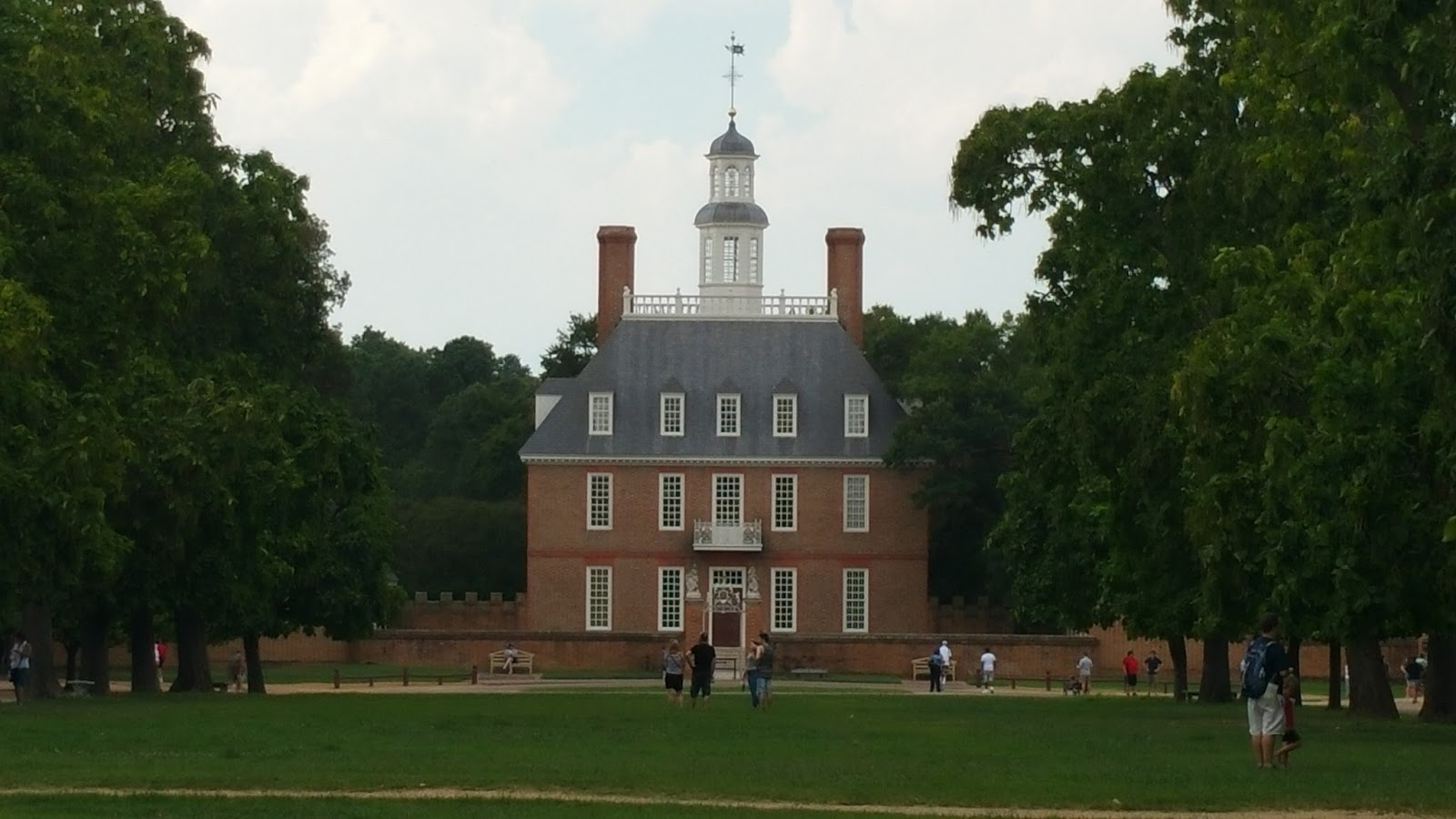
The Governor's Palace

A view of the main street

Another street view

Viewing the town from the Courthouse, on one end

Many of the buildings have been turned into gift shops, some of which sell what might be considered "original" items, such as the silversmith, milliner and general store.  But the rest are overloaded with typical tourist souvenirs.

Costumed characters roam about the town and work in kitchens, shops and taverns (in which you can actually get a meal).  

A townswoman

A townsman

Another man about town

British soldier

The basket weaver
She was making the most amazing baskets.  None were for sale (darn, darn!) as they were being made to actually use in the village by the townspeople.

The village puts on reenactments periodically throughout the day and we were able to see a few.  The first was a reading of the Declaration of Independence by the town crier, followed by a rousing speech to the town about why they should all support the effort.

Reading of the Declaration of Independence to the townspeople of Williamsburg (and a few tourists!)

Discussing the state of war

The call to arms was a rousing speech by a militia officer about the need for volunteers to staff the fledgling army, followed by a little selling and the winning over of the family members staying at home.

"The Army needs you!"

"Enlistment will pay you a wage that will help support your family."

 
"Don't go!  Who will take care of us?"

We went into a lot of the buildings, either for tours, to shop or eat.

The apothecary shop
This woman was very knowledgeable about 17th century treatments.

The carpenter shop
They actually build furniture with the old methods that you can order for your own home.

Colonial food
This, surprisingly to me, was actually real food actually being prepared in the kitchen of the Governor's Palace.  The kitchen was in an outbuilding and the constantly burning fire made the room extremely hot.  Can't imagine cooking three meals a day there!

While the original capitol of Virginia was at Jamestown, it was moved to Williamsburg in 1699, where it remained until 1779 when it was moved to Richmond.

Inside the Old Capitol
The guide did a very good job of discussing the type of government existing at the time.


Entry Hall, Governor's Palace
What is shown is just a fraction of the armament displayed.

Not sure what room this would be considered, but I found the wig to be interesting.

The dining room/office of the Governor's Palace


The keeper of the Magazine
Sid was thrilled to discuss firearms with the keeper.  I asked if there was a reason why the building was the shape is was, but he didn't have and answer.  I also wondered why this building is called a Magazine and my research didn't come up with anything.  Any of you readers know?

The final reenactment of the day was to be a briefing about the status of the war and a display of the Fife and Drum corp, so we had to stay for that even though we were pretty tired by 5:00 in the afternoon after walking around in 90% humidity all day!  I'm glad we did - it turned out to be one the of highlights of the visit.

Sid needing a nap!

The Fife and Drum Corps
They went around and "recruited" all the kids visiting that day to join the parade.

On the parade ground

Giving a status update and pep talk to the townspeople

Inspecting the troops

A surprise visit from - George Washington
He played his role brilliantly!


Firing of the cannon on the town parade grounds

It had been a long day and with patriotic feelings at a high, we departed Colonial Williamsburg and returned to the 21st century.  But, you know, I always seem to find something a bit weird or quirky wherever I go.  So I'll leave you with some things to ponder.

Jail toilet
There were one of these structures in each jail cell.  I couldn't figure our why they needed to build it up like that, but they were all the same.

Even the residents of the Governor's Palace had to have a place to go, if you know what I mean!

Tavern entertainer
He played songs while we ate lunch at the tavern. Look closely at his...ahem....posterior.

A little closer
 I spent the rest of the day looking at the men's butts - all the pants in the colony were made the same way.  While I did ask a woman about her corset, even I didn't have the nerve to question this gentleman about his pants!

Until next time...